

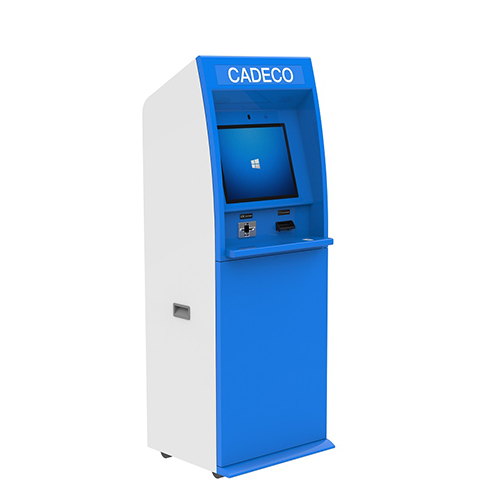
An ATM machine with cash deposit and withdrawal helps financial institutions handle routine cash transactions without requiring customers to visit a staffed teller counter. However, choosing the right ATM involves more than checking its basic functions. You need to consider banknote recognition, cash storage capacity, transaction security, card compatibility, and equipment reliability. These factors directly affect how customers complete deposits and withdrawals and how operators manage cash.
The XTD Lobby ATM combines cash recycling, card reading, receipt printing, and a large touchscreen in one self-service terminal. Manufactured by Shenzhen Xingtongda Information Technology Co., Ltd., it provides an ODM/OEM solution for businesses seeking customizable ATM equipment for banks, commercial facilities, and other public service environments.
How the XTD ATM Machine with Cash Deposit and Withdrawal Works
The XTD Lobby ATM features a banknote circulation system designed to process deposited and withdrawn banknotes. Its configuration includes four circulation boxes, one recycling/mixed storage box, and one forgotten-banknote recycling box.
This system supports several important cash-handling operations:
- Banknote recognition: Identifies and counts banknotes deposited by customers before reporting the results to the ATM-PC.
- Cash deposit: Transfers accepted banknotes into the designated cash box.
- Cash withdrawal: Retrieves stored banknotes after identification when the ATM-PC requests a withdrawal.
- Two-way auditing: Supports reconciliation between the banknote box and audit box when the applicable configuration is installed.
- Multi-currency processing: Handles different banknote sizes and can support different currencies through identification software updates.
These functions make the terminal suitable for financial service environments where customers need both deposit and withdrawal options.
Note that the three-banknote-box configuration does not support the stated audit function. You should confirm the required cash box configuration before ordering.
Key Hardware Specifications of the Lobby ATM
Hardware selection affects processing performance, display quality, and daily operation. The XTD Lobby ATM uses an Intel-based main control module and dedicated peripherals to support its self-service functions.
| Component | Specification |
|---|---|
| Main control module | SV1-12S2A-H610 |
| Processor | Intel Core i5-12400, 6 cores and 12 threads |
| Memory | Kingston 8GB |
| SSD | Kingston 128GB |
| HDD | Seagate 1TB mechanical hard drive |
| Operating system | Microsoft Windows |
| Display | 27-inch LCD, 16:9 |
| Resolution | 1920 × 1080 @ 60Hz |
| Brightness | 250 cd/m² |
| Contrast ratio | 1000:1 |
| Power supply | 300W |
| Camera | 2MP monocular camera or 5+2MP binocular camera |
| Printer | Thermal printer, maximum speed 150mm/s |
The main control module supports Intel 12th, 13th, and 14th Generation Core i3/i5/i7/i9 processors, as well as Pentium and Celeron processors, with a maximum CPU TDP of 65W.
The included Intel Core i5-12400 provides six cores and twelve threads, offering a hardware platform for ATM software and peripheral communication.
Integrated UPS Power Protection
The equipment specification also includes a UPS rated at 500VA/300W. Its battery configuration uses one 12V 7Ah maintenance-free sealed lead-acid battery.
Other important parameters include:
- Backup time: Up to 10 minutes for a single PC.
- Charging time: Approximately 4–6 hours.
- Transfer time: 10ms or less.
- Output voltage: 220V ±10%.
- Communication interfaces: RS232 and RJ11.
This UPS configuration helps maintain short-term power continuity. Actual backup time depends on the connected load and operating conditions.
Card Reading and Receipt Printing Capabilities
For financial self-service applications, reliable communication between the ATM, bank card, and transaction software is essential.
The XTD Lobby ATM supports magnetic card reading and writing, contact IC card reading and writing, and a SAM card holder. Its card reader also includes electric card insertion and ejection, back-end card swallowing, and front-end card input.
Its stated testing and certification credentials include:
- CE and RoHS testing and certification.
- EMV 4.2 Level 1 testing and certification.
- PBOC 3.0 Level 1 testing and certification.
- Power failure protection.
- Support for a card-slot anti-skimming module.
The terminal also integrates a line thermal printer for transaction receipts and other printed records.
Printer specifications:
- Printing speed: Up to 150mm/s.
- Printing density: 8 dots/mm.
- Paper width: 79.5 ±0.5mm.
- Effective printing width: 72mm.
- Paper cutting: Automatic full or partial cutting.
- Power supply: DC24V/2A.
These features allow operators to configure a self-service terminal around common banking transaction requirements.
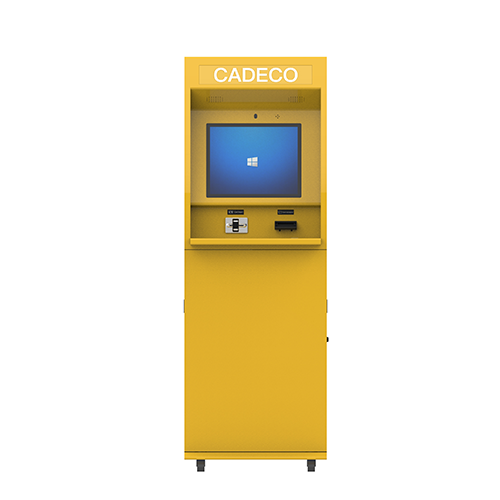
Lobby ATM vs. Standard Self-Service Payment Kiosk
Not every self-service kiosk needs a banknote circulation mechanism. Understanding the differences helps you select equipment that matches your payment environment.
| Comparison | XTD Lobby ATM | Standard Payment Kiosk |
|---|---|---|
| Cash deposit | Supported | Depends on configuration |
| Cash withdrawal | Supported | Not typically included |
| Banknote recognition | Integrated | Optional or unavailable |
| Cash recycling | Supported | Not typically included |
| Card reading | Magnetic and contact IC | Depends on configuration |
| Receipt printing | Thermal printing | Optional |
| Typical applications | Banking and financial services | Retail and public payments |
If your project requires both cash deposits and withdrawals, an ATM with an integrated cash recycler offers a more suitable hardware configuration than a basic payment kiosk.
Where Can You Install a Lobby ATM Machine?
The XTD Lobby ATM is designed for indoor self-service payment environments. Its cold-rolled steel enclosure provides structural rigidity for regular commercial use.
Potential installation environments include:
- Banks and financial institutions: Support customer cash deposits and withdrawals through self-service terminals.
- Hospitals: Provide payment services in designated financial service areas.
- Shopping malls: Offer convenient financial services for visitors.
- Subway and railway stations: Support self-service financial transactions in transportation facilities.
- Parking facilities: Provide an additional self-service payment option where the application requires ATM functions.
- Commercial service centers: Integrate financial services into existing self-service equipment areas.
Before installation, you should evaluate floor space, electrical connections, network availability, cash management procedures, and local financial compliance requirements.
How to Customize an ATM Machine for Your Project
Different financial institutions and system integrators have different equipment requirements. Shenzhen Xingtongda Information Technology Co., Ltd. provides ODM/OEM manufacturing services to support customized self-service terminal projects.
You can follow these steps when planning your ATM order:
- Define transaction requirements: Determine whether your project needs cash deposits, withdrawals, banknote recycling, card reading, or additional payment functions.
- Select hardware configurations: Confirm the processor, memory, storage, cameras, display, printer, and UPS specifications.
- Choose cash handling components: Specify the circulation box configuration and confirm whether the two-way audit function is required.
- Confirm card reader compatibility: Check the required magnetic card, IC card, SAM, and financial protocol specifications.
- Review the prototype: Evaluate the equipment structure, hardware integration, and operating requirements before mass production.
- Arrange production and delivery: Confirm the order specifications, inspection requirements, packaging, and delivery schedule.
XTD operates a professional sheet metal workshop equipped with Swiss Bystronic 4000W and 3000W laser cutting equipment, CNC bending machines, riveting machines, and welding equipment. Its production and testing facilities also include production lines, test lines, and aging lines.
For standard products, the stated lead time is approximately 7–15 days. Customized prototypes generally require 25–35 days, while ODM/OEM mass orders usually take around 30 days, depending on project requirements.
FAQ
1: Can the XTD Lobby ATM support both cash deposits and withdrawals?
Yes. Its cash circulation system identifies deposited banknotes, stores accepted notes, and retrieves identified banknotes for withdrawal when requested by the ATM-PC.
2: Can I customize the ATM hardware and appearance?
Yes. XTD provides ODM/OEM manufacturing services. You can discuss hardware configurations, enclosure requirements, display options, card readers, and other functional modules with its engineering and sales teams.
3: What is the warranty period for the XTD ATM machine?
XTD generally provides a one-year warranty after shipment. After the warranty expires, the company can provide paid maintenance and support services.
Conclusion
Choosing the right ATM machine with cash deposit and withdrawal requires careful consideration of cash handling, card compatibility, hardware specifications, and manufacturing capabilities. The XTD Lobby ATM integrates a banknote circulation system, magnetic and IC card reading, thermal receipt printing, a 27-inch display, and UPS power protection into one terminal.
With its sheet metal manufacturing facilities and ODM/OEM capabilities, Shenzhen Xingtongda Information Technology Co., Ltd. can support businesses looking for customized ATM kiosk solutions for financial and commercial applications.
Looking for an ATM manufacturer for your next project?
Contact Shenzhen Xingtongda Information Technology Co., Ltd. to discuss your cash deposit and withdrawal requirements, hardware configuration, and OEM/ODM customization needs. Share your project specifications to receive a suitable equipment proposal and production schedule.
